
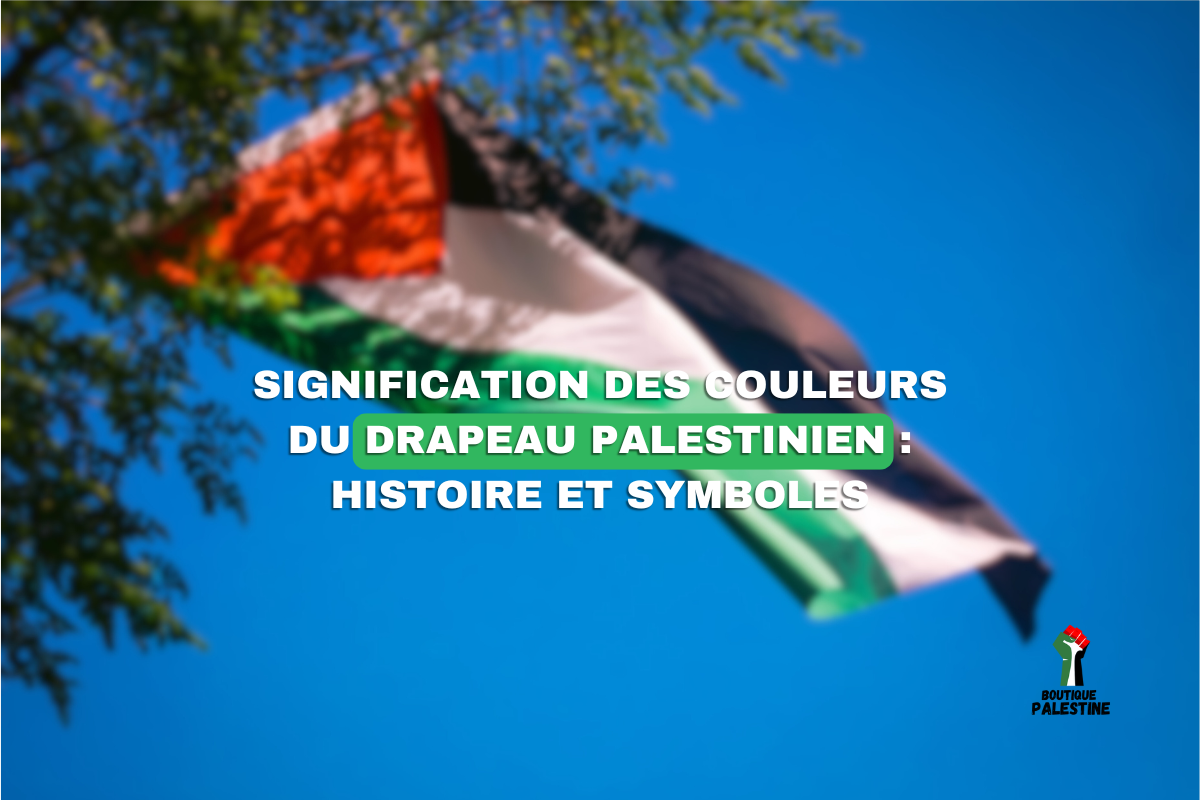
The Palestinian flag is one of the most recognisable symbols in the world. Its four colours — black, white, green and red — tell centuries of history, resistance and collective identity on their own. Whether you want to understand what the flag means, trace its origins or simply show your solidarity, this article explains everything.
Contents
The origins of the Palestinian flag
The Palestinian flag as we know it today has its roots in the Arab Revolt of 1916, when Arab nationalists rose up against Ottoman rule. They adopted a shared banner whose colours were chosen to represent the great Islamic dynasties that shaped the history of the Arab world.
These pan-Arab colours — black, white, green and red — were later taken up by many Arab nationalist movements throughout the 20th century. Palestine was no exception.
In 1964, the Palestine Liberation Organization (PLO) formally adopted the flag as the emblem of the Palestinian people. Then, on 15 November 1988, when Yasser Arafat proclaimed the State of Palestine in Algiers, it became the flag of the State of Palestine — a state now recognised by more than 150 countries.
Since then, it has flown at international diplomatic bodies and at the UN, in streets around the world during solidarity marches, and on countless garments and accessories worn as a sign of commitment.
The meaning of each colour of the Palestine flag
The design is simple and precise: three horizontal stripes (black at the top, white in the middle, green at the bottom) with a red triangle at the hoist. Each element has its own meaning.
Black: memory and resistance
The black stripe is historically associated with the Abbasid dynasty, which ruled much of the Muslim world between the 8th and 13th centuries. In the Palestinian context today, black takes on a deeper meaning: it evokes collective mourning, forced exile, destruction and the sacrifices endured by entire generations. It is the colour of living memory — of what is never forgotten.
White: peace and dignity
White refers to the Umayyad dynasty, founder of the first great Islamic empire. On the Palestinian flag, it now embodies the aspiration to peace and justice. It symbolises the purity of the cause and the hope of international recognition based on law. It is the colour of dialogue and dignity.
Green: the land and identity
Green is associated with the Fatimid dynasty and with Islam in its spiritual dimension. But for Palestinians it represents above all the land itself: olive groves, orchards and the landscapes of Galilee and the West Bank. The same symbolism appears in iconic cultural objects such as the Palestinian keffiyeh, whose woven patterns evoke olive leaves, fishing nets and trade routes.
Red: sacrifice and solidarity
The red triangle, the flag’s most distinctive feature, comes from the Hashemite movement of the Arab Revolt. It symbolises the blood shed and the sacrifices made for freedom, as well as solidarity between Arab peoples. Today, red is also the colour of activism: you’ll see it on Palestine t-shirts, scarves and flags raised at marches around the world.
Show your solidarity with the Palestinian people
Flags, keffiyehs, football shirts and jewellery — free tracked uk delivery on orders over £40
A flag recognised around the world
The Palestinian flag reaches far beyond its region. The State of Palestine is now recognised by more than 150 countries — including the United Kingdom, which formally recognised it in September 2025, alongside Canada, Australia, France and others. In 2012, Palestine was granted non-member observer state status at the United Nations — a major symbolic milestone.
Internationally, the flag has become a rallying sign well beyond the Palestinian cause alone. For many, it represents the wider struggle for human rights, self-determination and international justice. From European capitals to Latin America and sub-Saharan Africa, the Palestinian flag is visible at major public demonstrations.
In the UK, the Palestinian flag is a familiar sight at marches in London, Manchester, Glasgow and across the country, showing how much emotional and political weight the symbol now carries.
Can you fly the Palestinian flag in the UK?
It’s a question that often comes up: is it legal to display the Palestinian flag in the UK? Yes. Flying or wearing a Palestinian flag — in the street, in your window or at a march — is protected by freedom of expression, as long as it isn’t accompanied by threats, hatred or violence, and follows the usual rules on public order and on flags displayed outside buildings.
You can therefore wear the Palestinian flag freely on clothing or accessories, or display it as a decorative object at home.
Palestinian flag vs Jordanian flag: what’s the difference?
The Palestinian flag and the Jordanian flag look alike at first glance, which sometimes causes confusion. Both share the same pan-Arab colours and the same basic layout. But there are important differences:
- The Jordanian flag has a white seven-pointed star in the red triangle, representing the seven verses of the opening surah of the Qur’an, Al-Fatiha.
- The Palestinian flag has no symbol in its red triangle — it is simpler and more direct in its symbolism.
- The stripes are ordered the same way, but the proportions of the red triangle differ slightly between the two flags.
This visual closeness reflects a shared history: the two peoples share geographical and cultural roots, and both flags come from the same Arab nationalist movement of the early 20th century.
How to show your support for Palestine every day
Beyond the flag itself, there are many ways to express solidarity with Palestine every day:
- The Palestinian keffiyeh — the ultimate symbol of resistance, worn for decades by political and artistic figures around the world.
- Palestine bracelets — discreet and worn on the wrist, they show a sincere commitment every day.
- Palestine football shirts — to support a national team that keeps playing against all odds.
- Palestine flags — to hang at home, give as a gift or carry at gatherings.
- Palestine badges — including the famous watermelon pins, now a cultural symbol in their own right.
Wear your values every day
Keffiyehs, bracelets, football shirts and badges — free tracked uk delivery on orders over £40
Frequently asked questions about the Palestine flag
What does the Palestinian flag mean?
The Palestinian flag has three horizontal stripes (black, white and green) and a red triangle. Black symbolises memory and resistance, white peace and dignity, green the land and identity, and red sacrifice and solidarity.
When was the Palestinian flag adopted?
The flag was formally adopted by the PLO in 1964 and became the flag of the State of Palestine with the declaration of independence in Algiers on 15 November 1988.
Can you display the Palestinian flag in the UK?
Yes. Displaying or wearing the Palestinian flag is protected by freedom of expression in the UK, as long as it isn’t accompanied by threats, hatred or violence.
What is the difference between the Palestinian and Jordanian flags?
The main difference is that the Jordanian flag has a white seven-pointed star in its red triangle, while the Palestinian flag does not.
How many countries recognise the State of Palestine?
More than 150 countries recognise the State of Palestine, including the United Kingdom since September 2025. Palestine has been a non-member observer state at the UN since 2012.
Where can I buy a Palestinian flag in the UK?
You can buy a Palestinian flag from Palestine Wear, with free tracked UK delivery on orders over £40.